Showing posts with label Spain. Show all posts
Showing posts with label Spain. Show all posts
Monday, May 18, 2015

Saturday, July 19, 2014
.JPG)
Tuesday, July 1, 2014


Sunday, March 9, 2014

Thursday, October 17, 2013


Wednesday, September 25, 2013
Small Bizarres No. 67 - the Mail-Boxes of a Big Family, Benalmadena, Spain...
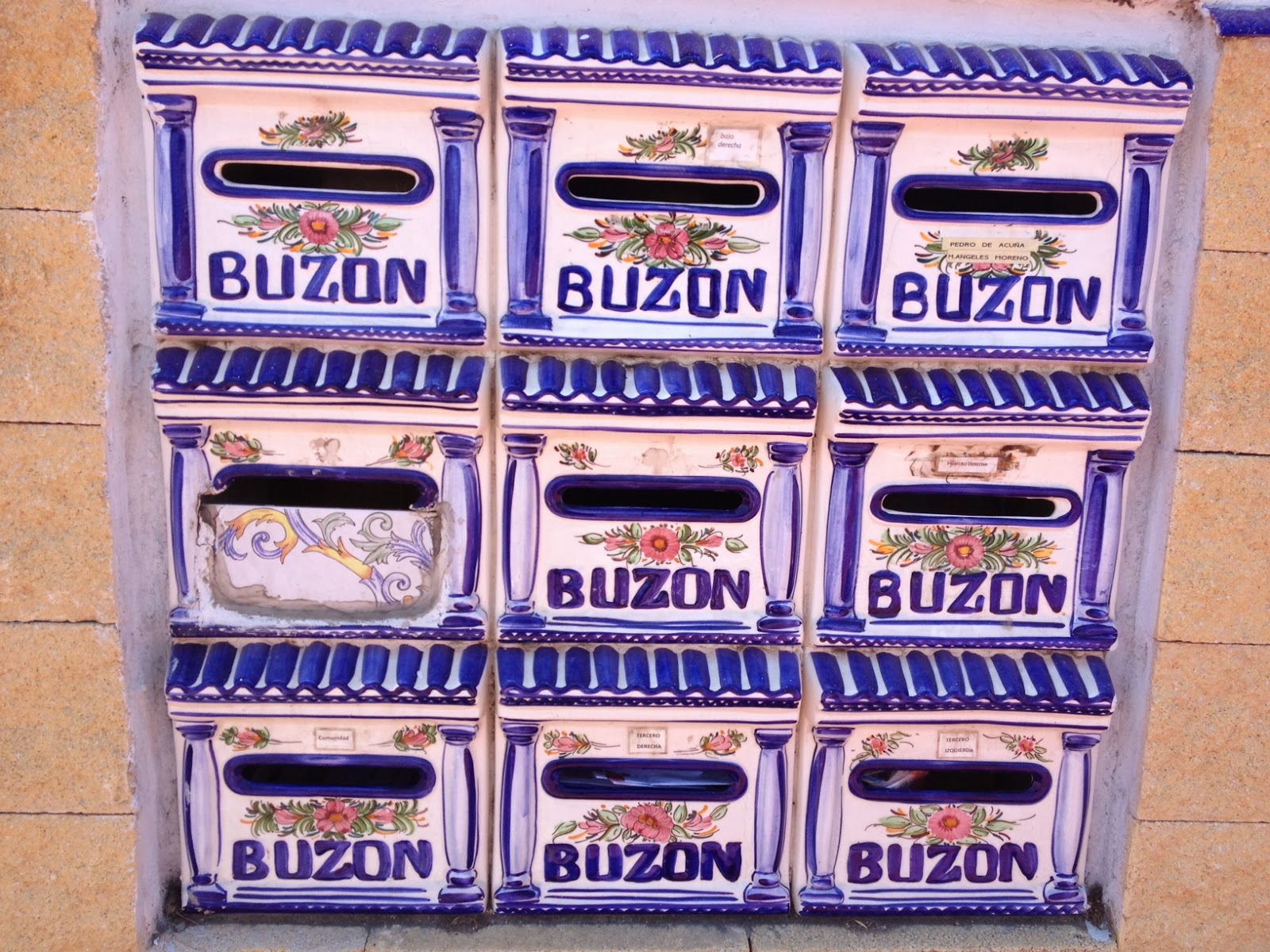 |
| One big, happy family - the Buzons. Living in close proximity to each other... |
Monday, July 1, 2013

Sunday, March 25, 2012
Accessible Sculpture, Barcelona...

Doha has its fair share of public sculpture (usually in the form of 'sculptural' buildings, as can be observed in the Westbay district of the city). Very often though, such pieces are inaccessible to the public, as many of these are placed in the middle of traffic roundabouts or within private office buildings. Until now this has even applied to the Richard Serra piece outside the MIA that, during my last visit to the adjacent park a few weeks back, was still fenced off to the public. In comparison Barcelona has managed to integrate such interventions in a more natural and approachable fashion, and done so in collaboration with both local artists/ designer (see above sculpture by Marsical) or featuring work by other internationally renowned artists/ architects such as Roy Lichtenstein or Frank Gehry, all which can be walked up to and directly engaged with... It would be great to both create more such pieces, as well as places where such pieces could be realized and accessed (and also do so in a smaller scale within various residential and peripheral districts), here in Doha...

Top and Above: Sculpture by Javier Marsical

Above and Below: A piece by Roy Lichenstein

Friday, December 30, 2011


Wednesday, November 23, 2011


Saturday, July 9, 2011

Friday, July 8, 2011
The Extraordinary Ordinary - Gorilla Hands, Fuengirola, Spain...

The palm and fingers of a bipedal - two photos of gorilla hands, taken at the Bioparc in Fuengirola, Spain...

Wednesday, August 18, 2010
A Zoo Worth a Visit...
 A tiger in a setting inspired by its origins...
Unfortunately many of the Gulf region's zoos leave much to be desired. With their often excessively cramped and dirty cages and incessantly pacing or spasmodic animals they often seem more like a zoological loony-bin than a place for observing animals in quasi-natural environments. To some degree this also applies to zoos elsewhere in the world. Consequently I was very pleasantly surprised when I visited the zoo, or Bioparc as it's officially named, in Fuengirola, a town near Malaga in the southern tip of Spain. The first thing that struck me was how dignified, if that is a word that can be used when talking about animals in captivity, the various critters and creatures seemed to be. Many had exponentially larger cages compared to zoos elsewhere which allowed visual access to the animals without necessarily interrupting their play or daily routines too much. The zoo is also surprisingly intimate, with its winding routes and selection of nooks & crannies providing access to the various animal habitats. They\re all also flanked by vegetation that seemed to be originating from the locales to each animal's origins... It's core concept is well thought through. It has omitted including large animals such as elephants or giraffes which inevitably would need very large enclosures. The whole zoo can be walked/ strolled through in less than two hours, thus avoiding 'visit-fatigue' from settling in. The park is clean and well maintained. The Bioparc provides a useful template for how this form of enterprises can and should be realized...

 Afternoon nap (or hunt)..?!
 Hungry-Hippo...
  Two become one...
  Morning stretch...
  Her domain...
  Follow the (junior) leader...
  Day-dreaming...
  Full Moon...
  Chillaxing...
 Thursday, September 10, 2009
Designed Spontaneity...
 A busker in Rome...
A successful city is often a contradictory city – where the mix of various cultures, cultural sub-classes and social taxons in close proximity provide it with a catalytic and dynamic vibrancy. How, however, such elements are allowed to coexist and interplay is where the magic formula of a dynamic and resilient city lies.
This benign form of subversiveness is what innovation is all about. New ideas aren't created in a vacuum, but are catalysed by exposure to a smorgasbord of different, frequently conflicting, ideas and forms of expression. It's about being inspired by exposure to unexpected sources of creativity – music inspiring architecture, biology affecting engineering, chemistry inducing a novel take on cooking. It's also about asking questions, as asking, defining, and aiming to solve queries is what research and progression is all about. A city's role and vigour is defined by what questions are asked. The features and activities included here are all reflections of such, more casual and spontaneous, street level interventions. But what the street says, has a tendency to 'trickle up' to eventually permeate the higher echelons of decision makers.
Kuwait is an interesting concoction of concurrent conservatism and tolerance, action and apathy, passion and indifference, progression and regressiveness - qualities that can often exists within the same body - be this 'body' an individual, family, neighbourhood or governmental unit, with many of the more 'exuberant' activities taking place behind the covert enclosures of its private residences. How some of these qualities might manifest themselves more openly as a potential generative resource in Kuwait remains to be seen.
Below are some 'spontaneous' elements found in most world cities. The list is in no way exhaustive, and based on a very subjective take on the matter, but hopefully some of them touch upon issues which at least in part could be adapted here in Kuwait to encourage something closer to a more vibrant city-scape...
Buskers & Street-Performers
As of yet I haven't come across a single busker of (ad hoc) street performer in Kuwait. This is partly due to the lack of street life in Kuwait, where today much of the more casual interactions take place within the hermetic and controlled confines of a mall.
 A street performer in London...
Wouldn't it be great to have a 'Busker's Corner' in one of the nooks of Avenues or Marina malls? A spot where aspiring performance artists of any discipline could come to promote their trade and gain experience performing. Create a place where anything from a shadow-puppet performance, sand-shuffle dance, or a drum & base/ beat-box rendition of an Om Kulthoum could be performed. These types of events would not only provide a welcomed distraction and alternative to the common shopping experience, but could also become something of an attraction in their own right.
 A (flamenco) busker in Malaga, Spain...
 A (flamenco) busker in Malaga, Spain...

A street (ladder) performer in London's Covent Garden...

A classical trio in Helsinki, Finland...
Protests & Communal Activities
Public activities, be it a protest or any other form of common event, are key to a city's health. They allow various factions to express and vent their feelings regarding issues that, at least to them, are of more heightened general interest and concern. Regardless of the gathering is for ten or ten-thousand individuals, a city needs to allow and provide facilities for them to take place. The alternative, to prohibit or discourage them, only fuels more covert rabble-rousing which seldom results in anything constructive.
 The percussion section of a protest march in Malaga...
 A communal dance performance (to Michael Jackson's 'Black or White') in Vilnius, Lithuania...
Based on the aforementioned heading, a city also needs spaces where such communal activities can take place. This doesn't necessarily mean (even though it can) that a city needs to retain a space only for these types of gatherings, but that there is a place which can be adapted for such public assemblages. Trafalgar Square in London is, along with being a tourist attraction, used mostly as a nodal hub for transport (there's a tube and train-station, as well as a major bus-stop next to it) but it also performs on select occasions as a place of performance and protest. The Spanish Steps in Rome is used as a central meeting point and a place for some people watching adjacent to some of the city's most exclusive shopping streets. Most cities contain this type of adaptable open areas which can be easily accessed and are commonly available. Places for a short breather, a shaded spot for reading, a quick cup of coffee or a bench for a quiet conversation as well as the occasional, more organized, sable-rattling...

The Spanish Steps in Rome...

Town square in Borgå, Finland...

A small neighbourhood square in Benalmadena, Spain...

Casual seating spots at the Alhambra, Granada, Spain...
Graffiti & Public Posters
Even though not appropriate everywhere, graffiti and various event or promotional posters can provide their share of eye-candy in any city. When done with skill and passion, and with an understanding for its context, they can enliven a usually unremarkable stretch of sidewalk or mediocre city wall. They, again, provide an outlet for various kindred, perhaps more subversive, spirits to vent their vexations and provide a skill-set which can hopefully be channelled into something more vocational (it was through graffiti, after all, that artists such as Keith Haring, Jean Michel Basquiat (Samo) and Kenny Scharf got their start)...

Above and all images below - some graffiti and a poster in Vilnius, Lithuania...


Animals
Humans are not the only consious living entities occupying a city. Beyond the roaches and rats, which any self-respecting urban environment can't seem to manage without, there are many animals which actually provide some harmless entertainment in their own right. Kuwait has its slender street-cats embellishing most garbage bins in the evenings. Other places have their own renditions of these semi-domesticated creatures, be these swans, ducks, fish, squirrels, rabbits, even city-foxes, sharing the city with their two-legged compatriots. Of course one should mention the fully domesticated animals that play their own role, and leave their own 'marks' (particularly in Paris), on the sidewalks of most more cosmopolitan cities, but, especially here in Kuwait, these seem to be few and far between.

A swan family in Helsinki, Finland...

Goldfish in Fuengirola, Spain...
 Palying Kuwaiti kittens...
Subscribe to:
Posts (Atom)